The Mystic Estate journal
Male or Female Miniature Poodle: Which Is Right for Your Family?
Mystic Estate · July 19, 2026

If you are wondering whether a male or female Miniature Poodle will be the better fit for your family, the most honest answer is reassuring: sex can affect a few practical parts of life, especially while a dog is intact, but it does not write the puppy’s whole personality. A thoughtful match begins with the individual puppy—how that puppy seeks connection, responds to novelty, settles after excitement, and fits the rhythm of your home.
Both male and female Miniature Poodles can be affectionate, bright, athletic, sensitive, playful, and deeply devoted companions. Instead of choosing from familiar “boys are this, girls are that” sayings, use sex as one detail in a larger decision that includes temperament, health, socialization, training, your resident pets, and your plans for spaying or neutering.
The short version: what matters most
- Choose the individual, not the stereotype. A puppy’s observed behavior and the breeder’s daily knowledge are more useful than a broad claim about males or females.
- Expect the same core Poodle needs. Either sex needs close family life, thoughtful socialization, reward-based training, exercise, mental work, and regular grooming.
- Understand intact-dog management. Females have heat cycles; intact males may be strongly interested in nearby females in heat. Both require secure, responsible supervision.
- Make sterilization decisions with your veterinarian. Timing is not one-size-fits-all and should reflect the individual dog’s breed, age, sex, health, role, and home environment.
- Tell the breeder what daily life really looks like. Children, work hours, visitors, other animals, activity level, and training goals all help a breeder recognize the best match.
What sex does—and does not—predict
The official AKC Poodle standard describes the Poodle as active, intelligent, well proportioned, and dignified. It places every Miniature Poodle—male or female—between more than 10 inches and no more than 15 inches at the shoulder. The standard does not offer one temperament for males and another for females.
That matters because many popular comparisons sound more certain than they are. You may hear that males are always cuddlier, females are always easier to train, males are more playful, or females mature faster. Real puppies do not arrive in two tidy personality packages. Within either sex, one puppy may be socially bold and busy, another thoughtful and observant, and another especially people-focused.
Sex also cannot tell you how a puppy will respond to your children, whether the puppy will enjoy a bustling household, how quickly the puppy recovers from a surprise, or how much support the puppy will need when learning to be alone. Those questions call for observation, history, and honest conversation.
Look for the puppy traits your home actually needs
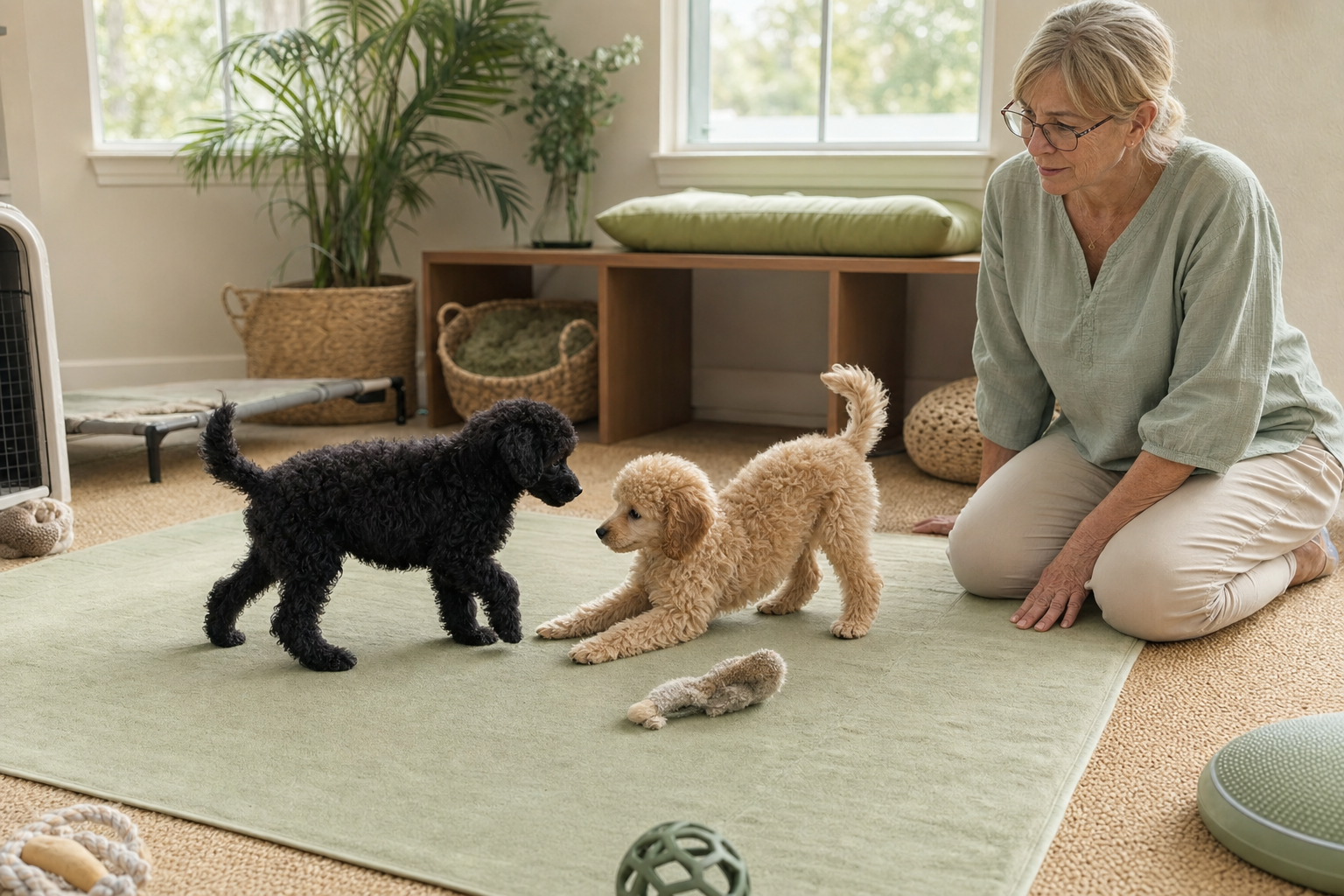
A good match is not simply the puppy who reaches you first or the puppy who sits quietly during one short visit. Breeders see the litter across meals, grooming practice, new surfaces, play, rest, frustration, visitors, and everyday household sounds. That longer view can reveal patterns that a family cannot see in a single exciting hour.
Useful traits to discuss include:
- Human orientation: Does the puppy regularly check in with people, and how does the puppy ask for contact?
- Recovery: After a harmless surprise, does the puppy bounce back readily or need more space and support?
- Activity and persistence: Does the puppy stay busy, work patiently at a puzzle, or tire quickly and settle?
- Play style: Is play gentle, physical, vocal, chase-oriented, or easily interrupted?
- Handling comfort: How does the puppy respond to brushing, paws being touched, being held briefly, and calm restraint?
- Independence and settling: Can the puppy rest away from littermates for a short period, or does the puppy need a slower transition?
None of these observations is a permanent score. Puppies are developing, and behavior is shaped by genetics, early experience, learning, health, and the environment they enter. The goal is not to predict every future moment. It is to begin with the most compatible pattern and then keep building on it.
Daily life is more alike than different
For most companion homes, male and female Miniature Poodles share far more than they differ. Both need an appropriate outlet for energy, regular chances to think, and a secure relationship with their people. Both can learn household manners, enjoy walks and games, participate in dog sports, and relax beautifully when their physical and mental needs are met.
The same is true of coat care. A male coat and a female coat both keep growing and can mat without consistent brushing and professional grooming. Our Miniature Poodle grooming guide explains the routine new families should expect, from combing to the skin to nails, ears, bathing, and cooperative handling.
Training quality matters more than sex. The American Veterinary Society of Animal Behavior recommends reward-based methods for all dog training and behavior modification. Short, clear practice sessions help either sex learn how to live successfully with your family. Socialization should also be paced to the puppy in front of you: a confident puppy and a cautious puppy may need different steps even when they are the same sex.

The practical differences while a dog is intact
The clearest male-female differences are reproductive, not promises about character. If your puppy will remain intact for any period, ask the breeder and your veterinarian what safe management will require before the puppy comes home.
Living with an intact female
Female dogs have estrous, or heat, cycles. The Cornell University College of Veterinary Medicine notes that a first heat can begin between 6 and 24 months, with smaller dogs tending to begin earlier than larger dogs. Most dogs cycle about twice per year, but timing and visible signs vary considerably between individuals.
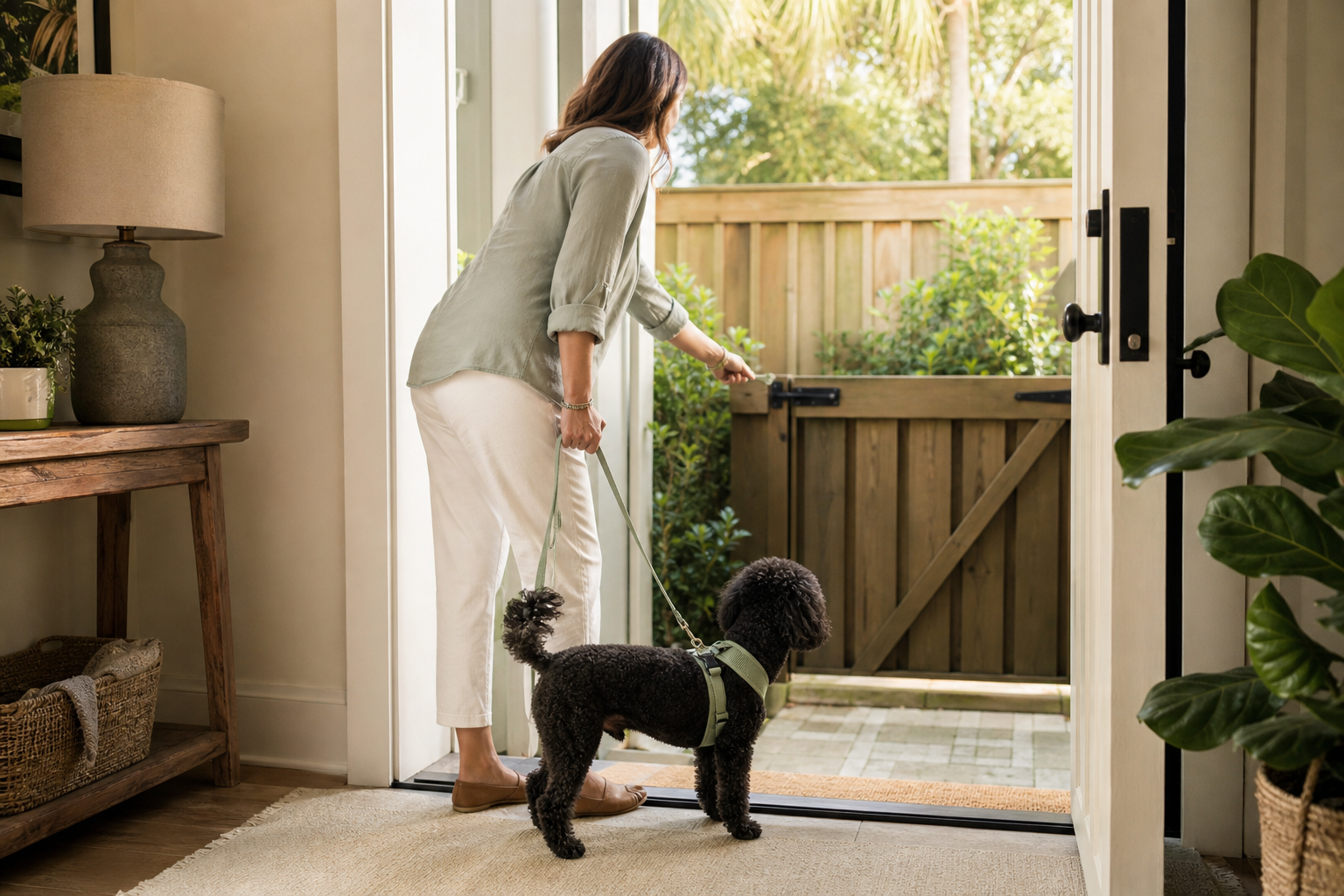
A heat commonly includes vulvar swelling and bloody discharge, and the dog can attract males before she is receptive to breeding. For a family, that means secure leash walks, supervised yard time, careful door and gate habits, avoiding off-leash areas and daycare, and preventing any access to intact males. Protective garments may help keep the home clean, but they do not prevent mating.
Living with an intact male
An intact male does not have a heat cycle, but he may become intensely interested when a female in the area is in season. Roaming, mounting, and urine marking can have a hormonal component. The Merck Veterinary Manual’s canine behavior guidance reports that castration can reduce these behaviors for many males, while also making clear that it is not a reliable way to prevent or resolve every form of aggression.
Training and management still matter. A neutered male can mark; an intact male can learn excellent house manners. Secure fencing, leash skills, recall practice, supervision, and preventing access to females in heat remain the owner’s responsibility.
Spay and neuter timing deserves an individual plan
The American Veterinary Medical Association’s pet-owner guidance says there is no one-size-fits-all recommendation for dogs. It advises families to make the decision with a veterinarian using the dog’s breed, age, sex, personality, role, home environment, and health status.
Discuss the plan early, including what your breeder’s contract requires and what the veterinarian recommends for this particular puppy. Sterilization prevents reproduction and changes exposure to reproductive hormones, but it should not be treated as a substitute for training, socialization, or behavior care.
What if you already have another dog?
Families are sometimes told that an opposite-sex pairing is automatically safest. Sex may be one consideration, particularly for intact dogs, but it is not a compatibility guarantee. The resident dog’s social history, age, health, play preferences, resource concerns, and tolerance for puppies are more useful than a simple formula.
Before choosing, tell the breeder how your current dog behaves around playful puppies, unfamiliar dogs, food, resting places, and human attention. A senior dog who wants quiet may struggle with the most persistent puppy of either sex. A social adult with a compatible play style may welcome a well-matched puppy when introductions and household management are thoughtful.
Plan initial meetings on neutral ground when appropriate, keep resources generous and separated, give both dogs protected rest, and supervise until their relationship is predictable. If your resident dog has a history of fear, guarding, or aggression, involve your veterinarian or a qualified veterinary behavior professional before bringing a puppy home.
What if your family has children?
A puppy’s sex does not make rough handling safe or eliminate the need for supervision. For homes with children, prioritize a puppy who can recover well, accept gentle handling, and settle after play. Then teach the people as carefully as you teach the puppy.
- Give the puppy a child-free crate or pen for sleep and decompression.
- Keep greetings low-key and let the puppy move away.
- Use adult supervision for every child-puppy interaction.
- Teach children not to hug, climb on, chase, wake, or corner the puppy.
- Trade for toys instead of pulling objects from the puppy’s mouth.
- End play before either the puppy or child becomes overwhelmed.
The best family puppy is not necessarily the boldest or the quietest. It is the puppy whose needs and style the adults can consistently support.
How a thoughtful breeder helps with the match
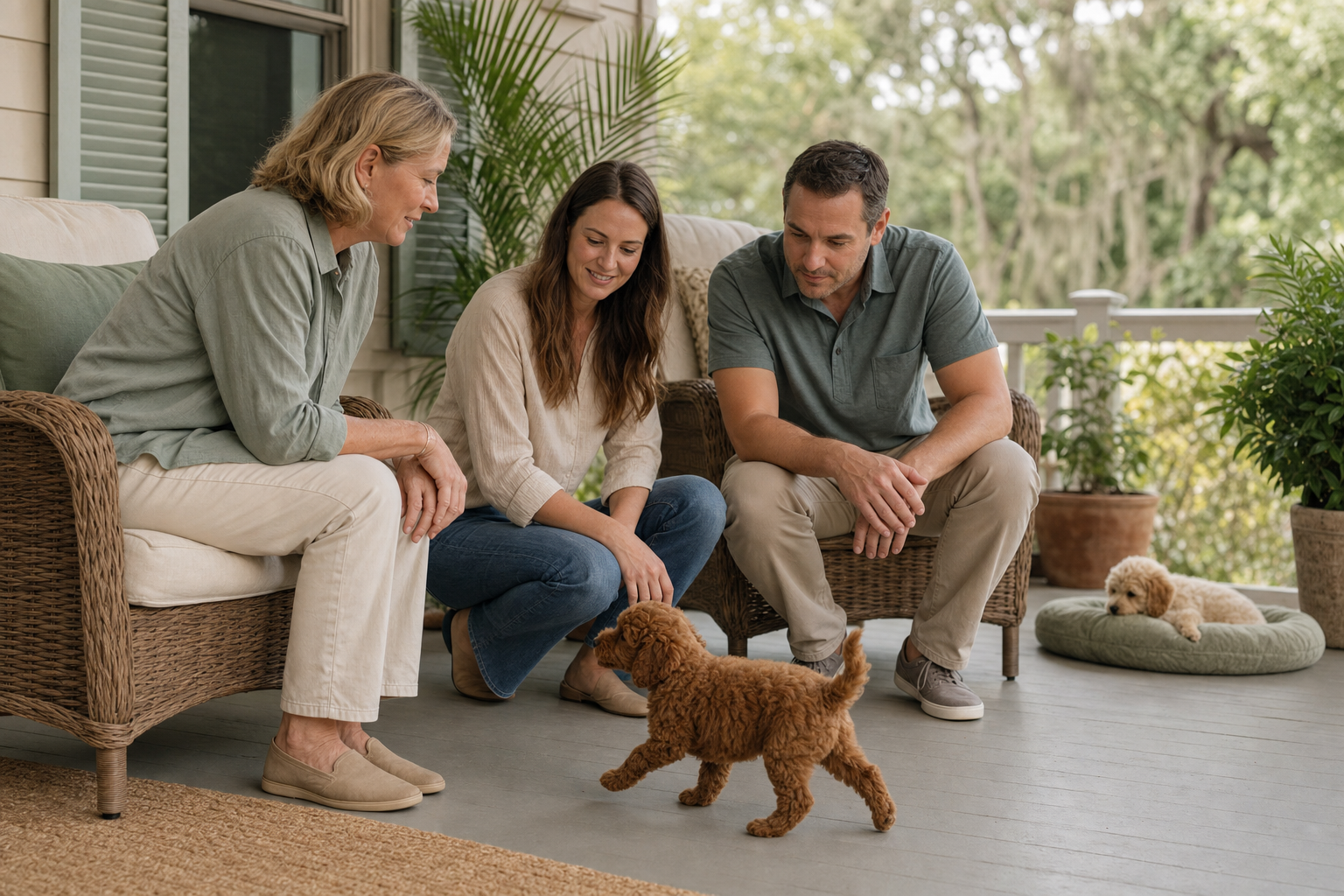
A breeder who lives with the litter can connect small daily observations to the life you describe. This is why a useful application asks more than “male or female?” It asks who lives in the home, how long the puppy will be alone, what other animals are present, how active the family is, what kind of training feels realistic, and what support the family may need.
Be candid. If you want a lower-key companion, say so. If you hope to hike, travel, compete in sports, or spend weekends with grandchildren, explain that. If barking sensitivity, stairs, frequent visitors, or a resident pet could complicate the match, share those details too. Honest information helps the breeder advocate for both the family and the puppy.
Questions to ask before choosing
- What differences have you consistently observed among the puppies in this litter?
- Which puppy recovers most easily after novelty or frustration?
- How does each puppy seek attention and how readily does each one settle?
- Has either puppy shown a play style that may or may not suit our resident dog?
- How has each puppy responded to brushing, nail handling, short separations, and confinement?
- What health testing was completed for the sire and dam?
- What does the contract require about spaying or neutering?
- If we have a sex preference, how might that affect our wait or the quality of the match?
You can review the breed-specific screenings responsible breeders should complete in our guide to Miniature Poodle health testing. Sex preference should never replace health, temperament, ethical raising, or transparent records.
When a sex preference is still reasonable
It is perfectly reasonable to have a preference. You may have experience managing one sex, a resident intact dog, a sport or breeding plan, or simply a strong personal comfort level. The important question is whether the preference is a practical requirement or a flexible wish.
If it is flexible, tell the breeder: “We lean toward a female, but the right temperament match matters more.” That gives the breeder room to introduce a puppy who may suit your home beautifully. If it is firm, be prepared to wait. A responsible breeder cannot promise the number, sex, health, or temperament of puppies before a litter is born and evaluated.
Red flags in a male-versus-female conversation
Pause if someone:
- Guarantees a personality solely because a puppy is male or female.
- Calls every male dominant or every female moody.
- Promises sterilization will automatically fix fear, aggression, or poor training.
- Minimizes the management required for heat cycles or intact males.
- Lets color and sex override health testing and temperament.
- Pushes you to choose immediately without learning about your household.
- Cannot explain why a particular puppy fits your family beyond appearance.
How to take the next step with Mystic Estate
You can meet our adult dogs on the Mystic Estate parent-dogs page, view planned litters, and see our available Miniature Poodle puppies in Florida. These pages give useful context, but a real match begins with a conversation about your home.
If you are ready to share your preferences and daily routine, complete our puppy application or contact Mystic Estate. A male-or-female preference can be part of that conversation without becoming the whole decision.
Frequently asked questions
Are male Miniature Poodles more affectionate than females?
Not reliably. Affection varies among individuals of either sex and is influenced by temperament, early experience, learning, health, and the relationship built with the family. Ask how each puppy seeks contact and settles near people instead of assuming all males behave alike.
Are female Miniature Poodles easier to train?
Sex does not remove the need for clear, reward-based training. Both males and females are intelligent Poodles and can be excellent learners. Engagement, motivation, consistency, developmental stage, and the skill of the handler matter more than a simple sex rule.
Do male Miniature Poodles get bigger than females?
Individual males may be larger than individual females, but the AKC Miniature Poodle height range is the same for both sexes: more than 10 inches and no more than 15 inches at the shoulder. Ask about the size of the parents and relatives, while remembering that a breeder cannot guarantee an exact adult measurement.
Is a male or female better with children?
Neither sex is automatically better. Look for a puppy whose recovery, handling comfort, activity level, and play style suit the household, then provide adult supervision, protected rest, and respectful child-puppy rules.
Is the opposite sex always best for a second dog?
No pairing is automatic. Sex can be one factor, especially when dogs are intact, but the resident dog’s history and preferences and the puppy’s play style, persistence, and social skills deserve more weight. Plan gradual introductions and get professional help when the resident dog has behavior concerns.
Should I decide on spaying or neutering before choosing a puppy?
You should understand the breeder’s contract and be ready to discuss timing with your veterinarian. The AVMA recommends an individualized decision for dogs rather than one universal age. Your plan should include preventing accidental breeding until the procedure is completed, if sterilization is chosen.
The best answer is a well-matched individual
When choosing a male or female Miniature Poodle, let sex inform the practical conversation without allowing it to crowd out the traits that shape daily life. Look for a healthy, thoughtfully raised puppy whose energy, recovery, social style, and need for support fit what your family can genuinely provide.
A careful breeder will help you look past easy stereotypes and toward the puppy in front of you. That is where a lasting match begins: not with a promise that one sex is better, but with clear expectations, honest observation, and a commitment to helping one particular Poodle thrive.

From our home to yours.
Meet the puppies behind the stories.
Meet our miniature poodles and tell Helen a little about the home you’re hoping to share.


Hi, I’m
Sterling!